
The Conversion Rate: The Cost of Staying Competitive
The cost of AI's future efficiency is far more brutal that we could have imagined; converting human capital into computing power.
18 minutes
Tech | Product | Leadership
Tania Makroo | Transformation Strategist
People | Jobs | Digital Work | AI
I want to start this reflection with a note clarifying, I am pro AI advancements, the kind that helps humans, because without humans, it's all just a simulation.
-Tania Makroo
A term spoken more in balance sheets than in boardrooms: the conversion rate. Typically, this lexicon belongs to the marketing department, defining the percentage of users who take a desired action, like buying a product, or in finance, the rate at which one currency is exchanged for another. But just like everything in life, a phrase can take on a new, more cynical meaning. This new conversion rate isn't about marketing funnels, customer acquisition, or converting your local currency to another. It's a far more brutal calculus, the rate at which an enterprise can convert its human capital into computing power. In the global race for AI dominance, we are now new-witnessing a fundamental shift in corporate value, where capital is being reallocated from payrolls to processors. The cost of staying competitive is now measured in gigawatts and petahashes, and that cost is being subsidized by the very workforce it promises to augment.
Petahashes is a technical term for a massive amount of computing power.
Hash: Think of this as a single calculation or a complex problem that a computer solves.
Peta: This is a unit prefix meaning one quadrillion (1,000,000,000,000,000).
So, a petahash per second means the ability to perform one quadrillion calculations per second.
Gigawatts (electrical power) and petahashes (computational power) together illustrates the immense physical and digital resources required to run modern AI. The money has to come from somewhere, right?
The Trillion-Dollar Bet
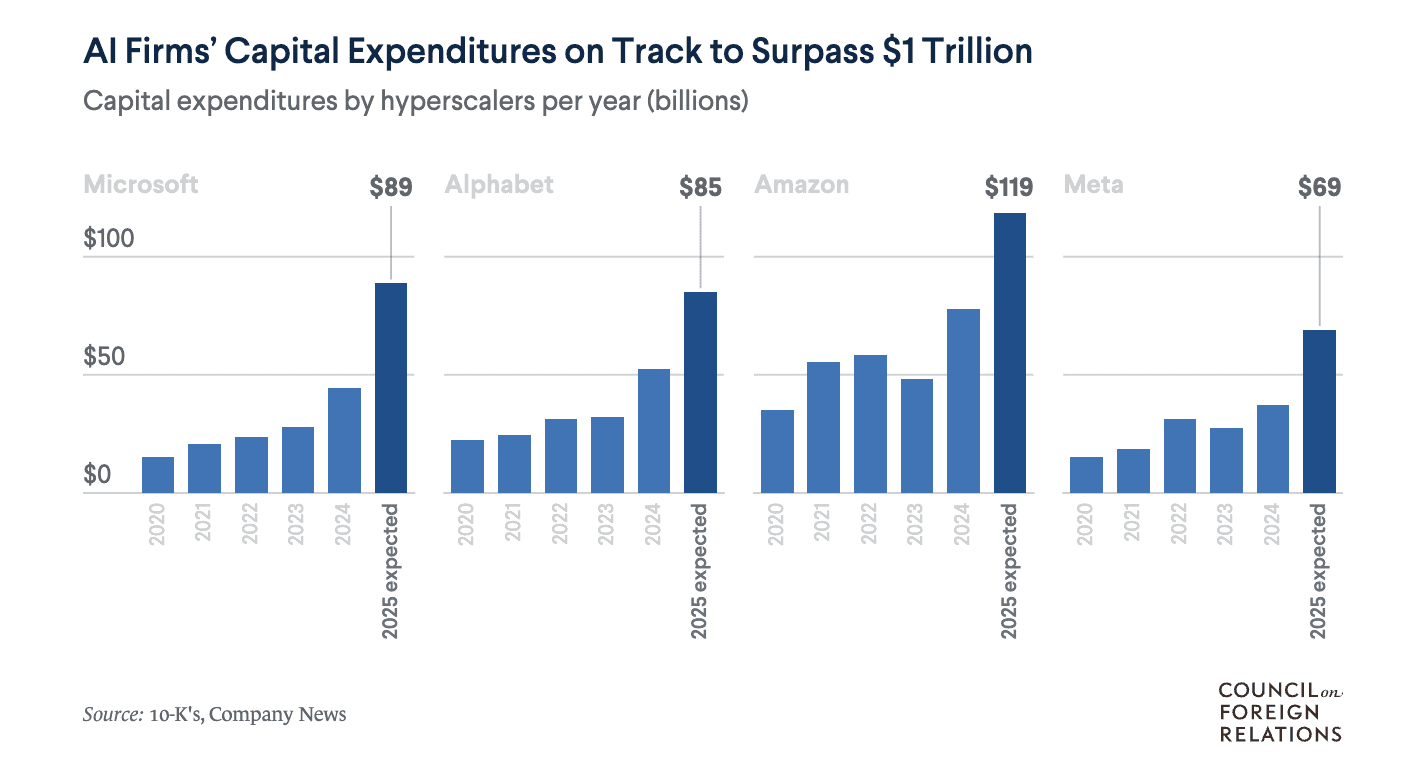
The sticker shock alone is staggering. Staying competitive in AI costs millions, and the industry’s giants are spending billions. Companies are projected to spend $375 billion on AI infrastructure in 2025 alone. Look at the capital expenditures of the hyperscalers: Microsoft has earmarked $80 billion, Amazon $86 billion, Alphabet $75 billion, and Meta over $60 billion. Combined, these four companies are spending over $450 billion in a single year on a strategic bet. McKinsey estimates the total capex required for AI-ready data centers will hit $5.2 trillion by 2030.
This isn't just an investment; it's an arms race, and the primary weapon is the GPU. With top-tier NVIDIA chips like the H100 and new Blackwell models costing upwards of $30,000 to $40,000 each, the new corporate mantra is a payroll for GPUs. Companies are building digital factories powered by silicon, and just like the industrial revolution, the new machinery is demanding a new kind of capital. As Meta’s CFO recently noted, employee compensation is only the second largest contributor to growth, reinforcing what is now the obvious, unstated truth: hardware is the new number one.
I want to start this reflection with a note clarifying, I am pro AI advancements, the kind that helps humans, because without humans, it's all just a simulation.
-Tania Makroo
A term spoken more in balance sheets than in boardrooms: the conversion rate. Typically, this lexicon belongs to the marketing department, defining the percentage of users who take a desired action, like buying a product, or in finance, the rate at which one currency is exchanged for another. But just like everything in life, a phrase can take on a new, more cynical meaning. This new conversion rate isn't about marketing funnels, customer acquisition, or converting your local currency to another. It's a far more brutal calculus, the rate at which an enterprise can convert its human capital into computing power. In the global race for AI dominance, we are now new-witnessing a fundamental shift in corporate value, where capital is being reallocated from payrolls to processors. The cost of staying competitive is now measured in gigawatts and petahashes, and that cost is being subsidized by the very workforce it promises to augment.
Petahashes is a technical term for a massive amount of computing power.
Hash: Think of this as a single calculation or a complex problem that a computer solves.
Peta: This is a unit prefix meaning one quadrillion (1,000,000,000,000,000).
So, a petahash per second means the ability to perform one quadrillion calculations per second.
Gigawatts (electrical power) and petahashes (computational power) together illustrates the immense physical and digital resources required to run modern AI. The money has to come from somewhere, right?
The Trillion-Dollar Bet
The sticker shock alone is staggering. Staying competitive in AI costs millions, and the industry’s giants are spending billions. Companies are projected to spend $375 billion on AI infrastructure in 2025 alone. Look at the capital expenditures of the hyperscalers: Microsoft has earmarked $80 billion, Amazon $86 billion, Alphabet $75 billion, and Meta over $60 billion. Combined, these four companies are spending over $450 billion in a single year on a strategic bet. McKinsey estimates the total capex required for AI-ready data centers will hit $5.2 trillion by 2030.
This isn't just an investment; it's an arms race, and the primary weapon is the GPU. With top-tier NVIDIA chips like the H100 and new Blackwell models costing upwards of $30,000 to $40,000 each, the new corporate mantra is a payroll for GPUs. Companies are building digital factories powered by silicon, and just like the industrial revolution, the new machinery is demanding a new kind of capital. As Meta’s CFO recently noted, employee compensation is only the second largest contributor to growth, reinforcing what is now the obvious, unstated truth: hardware is the new number one.
I want to start this reflection with a note clarifying, I am pro AI advancements, the kind that helps humans, because without humans, it's all just a simulation.
-Tania Makroo
A term spoken more in balance sheets than in boardrooms: the conversion rate. Typically, this lexicon belongs to the marketing department, defining the percentage of users who take a desired action, like buying a product, or in finance, the rate at which one currency is exchanged for another. But just like everything in life, a phrase can take on a new, more cynical meaning. This new conversion rate isn't about marketing funnels, customer acquisition, or converting your local currency to another. It's a far more brutal calculus, the rate at which an enterprise can convert its human capital into computing power. In the global race for AI dominance, we are now new-witnessing a fundamental shift in corporate value, where capital is being reallocated from payrolls to processors. The cost of staying competitive is now measured in gigawatts and petahashes, and that cost is being subsidized by the very workforce it promises to augment.
Petahashes is a technical term for a massive amount of computing power.
Hash: Think of this as a single calculation or a complex problem that a computer solves.
Peta: This is a unit prefix meaning one quadrillion (1,000,000,000,000,000).
So, a petahash per second means the ability to perform one quadrillion calculations per second.
Gigawatts (electrical power) and petahashes (computational power) together illustrates the immense physical and digital resources required to run modern AI. The money has to come from somewhere, right?
The Trillion-Dollar Bet
The sticker shock alone is staggering. Staying competitive in AI costs millions, and the industry’s giants are spending billions. Companies are projected to spend $375 billion on AI infrastructure in 2025 alone. Look at the capital expenditures of the hyperscalers: Microsoft has earmarked $80 billion, Amazon $86 billion, Alphabet $75 billion, and Meta over $60 billion. Combined, these four companies are spending over $450 billion in a single year on a strategic bet. McKinsey estimates the total capex required for AI-ready data centers will hit $5.2 trillion by 2030.
This isn't just an investment; it's an arms race, and the primary weapon is the GPU. With top-tier NVIDIA chips like the H100 and new Blackwell models costing upwards of $30,000 to $40,000 each, the new corporate mantra is a payroll for GPUs. Companies are building digital factories powered by silicon, and just like the industrial revolution, the new machinery is demanding a new kind of capital. As Meta’s CFO recently noted, employee compensation is only the second largest contributor to growth, reinforcing what is now the obvious, unstated truth: hardware is the new number one.

Echoes of Revolution
This isn't a new story; it's just the latest chapter in a long-running play. They say history repeats itself, and they are right. You just need to be observant to the themes and patterns. The set changes, but the plot remains the same. Let’s take a stroll down memory lane:
The 1st Revolution (Late 18th C.): We converted human muscle into steam and iron. This was the birth of the machine. The factory, powered by coal and water, remade the world by centralizing production. Skilled artisans who once controlled their own labor and pace found themselves becoming operators, subservient to the rhythm of the steam engine.
The 2nd Revolution (Late 19th C.): We converted steam into electricity and steel. This was the birth of mass production. The assembly line, famously championed by Henry Ford and powered by the new electrical grid, standardized the world. This new system, rooted in scientific management, broke down complex crafts into small, repetitive, timed tasks. The individual's skill was no longer the measure; their value was their speed and compliance with the line. Operators truly became cogs in a vast, interconnected machine.
The 3rd Revolution (Late 20th C.): We converted atoms into bits. This was the digital revolution. The microchip, and later the internet, powered by information, connected the world. Physical ledgers, paper memos, and analog calculations were "converted" into digital files and spreadsheets. The nature of office work transformed, and a new class of worker emerged, one whose primary function was to feed, manage, and process this new flow of information. Cogs became data entry.
The 4th Revolution (Early 21st C.): We converted bits into mobility. This was the revolution of ubiquity. The internet from the 3rd revolution broke free from the desktop computer. Through the mass adoption of Wi-Fi and the smartphone, the digital world became a permanent, persistent layer over our physical one. This shift converted people into 24/7 data generators, creating the massive, unstructured ocean of text, images, and preferences that would become the fuel for the next great conversion.
The 5th Revolution (Today): We are converting bits into thought. This is the AI revolution. The new factory is the data center, a massive, power-hungry infrastructure running on gigawatts of electricity. The new machine is the neural network, and its fuel is the ocean of data we all created in the 4th revolution. We are now automating the world of the office worker. The tasks of analysis, language, and even creative judgment are being converted into algorithmic processes. The worker whose job was to process bits is now seeing those bits seemingly learn to think. This leaves the previous generation's data entry worker in a new and precarious role: becoming... what? A prompter? A reviewer? Or simply obsolete?
What we are living through is not just a technological shift but a cultural one, where the factory is a server rack cooled by liquid, and the assembly line is an algorithm. The profound difference is the resource being automated: not just physical labor or simple calculation, but the human domains of language, judgment, and creativity.
-Tania Makroo
The Human Conversion
This is where the conversion becomes explicit. This capital isn't being created from thin air; it's being re-allocated. While headlines celebrate the multi-billion-dollar data center builds, other headlines, like those from The Wall Street Journal, tell the other half of the story: "Tens of Thousands of Office Jobs Are Disappearing as AI Starts to Bite." This isn't a coincidence. It's a balance sheet equation.
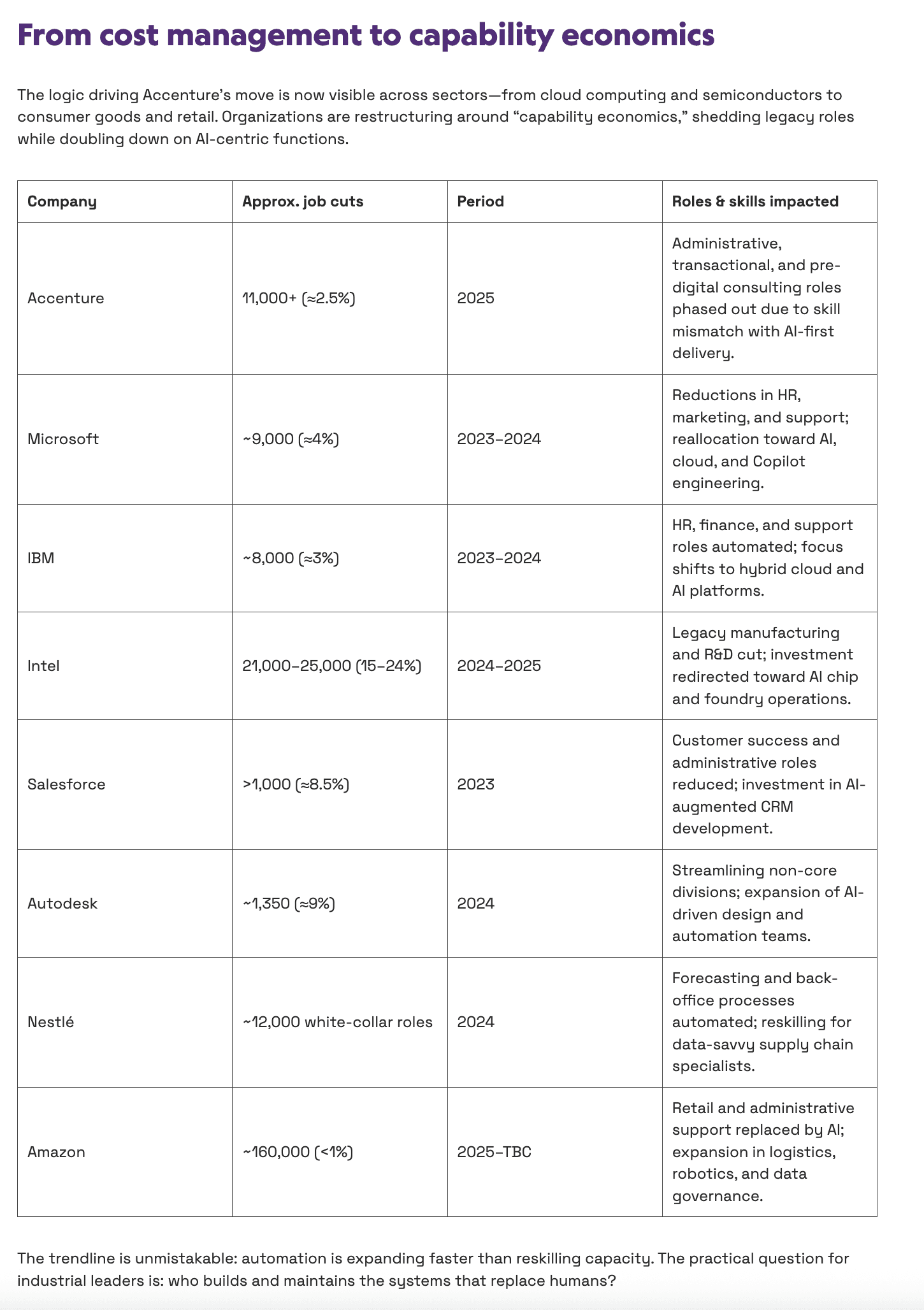
Let’s just look at the numbers. Amazon cuts 14,000 corporate jobs, nearly 10% of its office staff. UPS sheds 14,000 management roles. Target cuts 1,800. The tech industry at large, after laying off over 95,000 workers in 2024, has already cut another 80,000 in 2025. This is the chase for productivity in its rawest form, cutting people to fund the machines that are supposedly making everyone more productive.
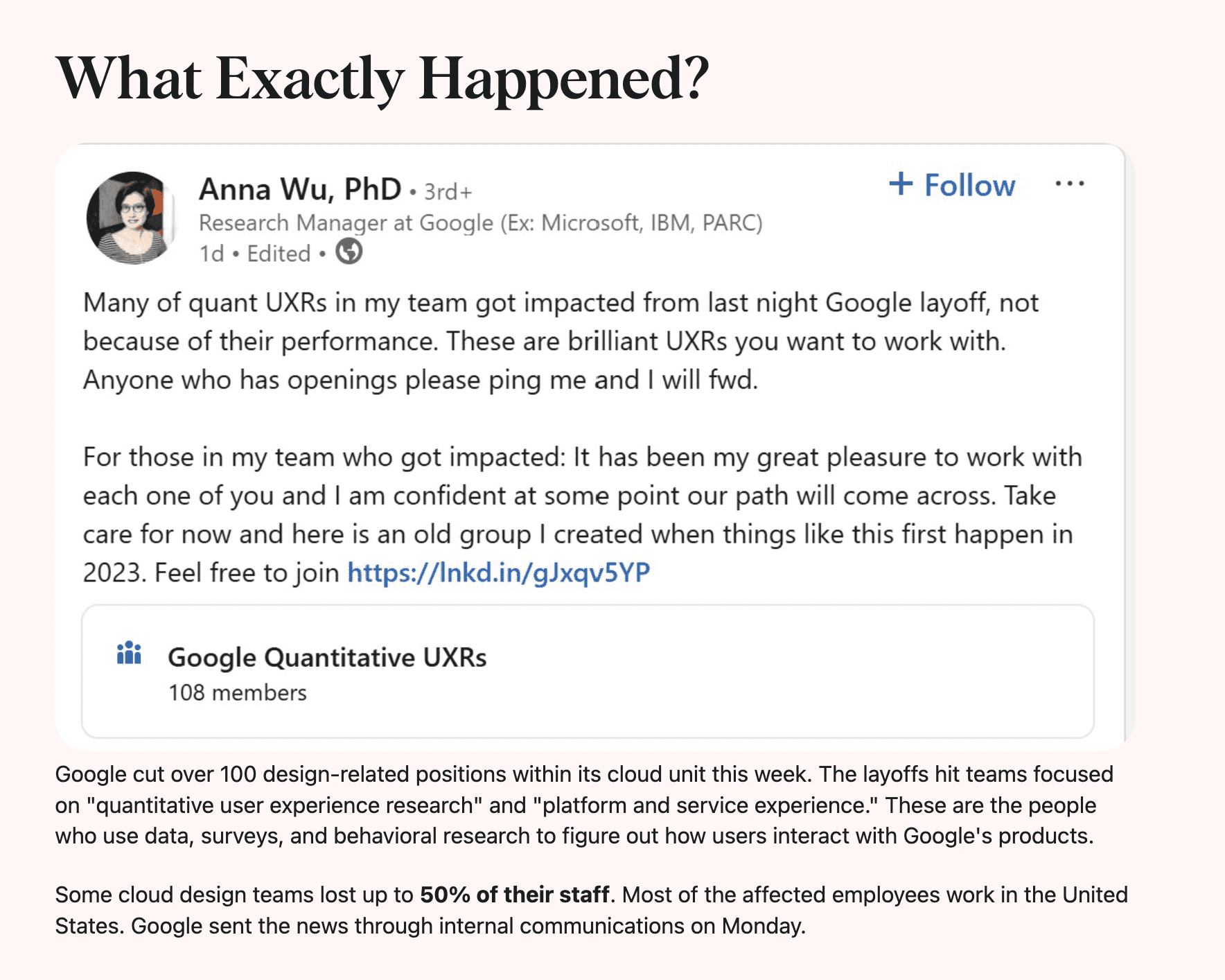
The examples are becoming more direct. The freelance marketplace Fiverr, for example, cut 30% of its workforce, with its CEO declaring the move was part of a necessary shift to an AI-first operation. Google is laying off hundreds from its design and user experience (UX) teams, signaling a strategic pivot from human-centered design to a more efficient, AI-first product development cycle. In finance, Morgan Stanley, while reporting record revenues, announced cuts of 2,000 jobs, explicitly citing the replacement of certain roles through AI and automation. Consulting firm Accenture was even more stark, cutting 11,000 jobs for employees deemed unable to be retrained for an AI-driven workforce, all while investing heavily to train 70,000 others in the new tools.

Echoes of Revolution
This isn't a new story; it's just the latest chapter in a long-running play. They say history repeats itself, and they are right. You just need to be observant to the themes and patterns. The set changes, but the plot remains the same. Let’s take a stroll down memory lane:
The 1st Revolution (Late 18th C.): We converted human muscle into steam and iron. This was the birth of the machine. The factory, powered by coal and water, remade the world by centralizing production. Skilled artisans who once controlled their own labor and pace found themselves becoming operators, subservient to the rhythm of the steam engine.
The 2nd Revolution (Late 19th C.): We converted steam into electricity and steel. This was the birth of mass production. The assembly line, famously championed by Henry Ford and powered by the new electrical grid, standardized the world. This new system, rooted in scientific management, broke down complex crafts into small, repetitive, timed tasks. The individual's skill was no longer the measure; their value was their speed and compliance with the line. Operators truly became cogs in a vast, interconnected machine.
The 3rd Revolution (Late 20th C.): We converted atoms into bits. This was the digital revolution. The microchip, and later the internet, powered by information, connected the world. Physical ledgers, paper memos, and analog calculations were "converted" into digital files and spreadsheets. The nature of office work transformed, and a new class of worker emerged, one whose primary function was to feed, manage, and process this new flow of information. Cogs became data entry.
The 4th Revolution (Early 21st C.): We converted bits into mobility. This was the revolution of ubiquity. The internet from the 3rd revolution broke free from the desktop computer. Through the mass adoption of Wi-Fi and the smartphone, the digital world became a permanent, persistent layer over our physical one. This shift converted people into 24/7 data generators, creating the massive, unstructured ocean of text, images, and preferences that would become the fuel for the next great conversion.
The 5th Revolution (Today): We are converting bits into thought. This is the AI revolution. The new factory is the data center, a massive, power-hungry infrastructure running on gigawatts of electricity. The new machine is the neural network, and its fuel is the ocean of data we all created in the 4th revolution. We are now automating the world of the office worker. The tasks of analysis, language, and even creative judgment are being converted into algorithmic processes. The worker whose job was to process bits is now seeing those bits seemingly learn to think. This leaves the previous generation's data entry worker in a new and precarious role: becoming... what? A prompter? A reviewer? Or simply obsolete?
What we are living through is not just a technological shift but a cultural one, where the factory is a server rack cooled by liquid, and the assembly line is an algorithm. The profound difference is the resource being automated: not just physical labor or simple calculation, but the human domains of language, judgment, and creativity.
-Tania Makroo
The Human Conversion
This is where the conversion becomes explicit. This capital isn't being created from thin air; it's being re-allocated. While headlines celebrate the multi-billion-dollar data center builds, other headlines, like those from The Wall Street Journal, tell the other half of the story: "Tens of Thousands of Office Jobs Are Disappearing as AI Starts to Bite." This isn't a coincidence. It's a balance sheet equation.
Let’s just look at the numbers. Amazon cuts 14,000 corporate jobs, nearly 10% of its office staff. UPS sheds 14,000 management roles. Target cuts 1,800. The tech industry at large, after laying off over 95,000 workers in 2024, has already cut another 80,000 in 2025. This is the chase for productivity in its rawest form, cutting people to fund the machines that are supposedly making everyone more productive.
The examples are becoming more direct. The freelance marketplace Fiverr, for example, cut 30% of its workforce, with its CEO declaring the move was part of a necessary shift to an AI-first operation. Google is laying off hundreds from its design and user experience (UX) teams, signaling a strategic pivot from human-centered design to a more efficient, AI-first product development cycle. In finance, Morgan Stanley, while reporting record revenues, announced cuts of 2,000 jobs, explicitly citing the replacement of certain roles through AI and automation. Consulting firm Accenture was even more stark, cutting 11,000 jobs for employees deemed unable to be retrained for an AI-driven workforce, all while investing heavily to train 70,000 others in the new tools.
Echoes of Revolution
This isn't a new story; it's just the latest chapter in a long-running play. They say history repeats itself, and they are right. You just need to be observant to the themes and patterns. The set changes, but the plot remains the same. Let’s take a stroll down memory lane:
The 1st Revolution (Late 18th C.): We converted human muscle into steam and iron. This was the birth of the machine. The factory, powered by coal and water, remade the world by centralizing production. Skilled artisans who once controlled their own labor and pace found themselves becoming operators, subservient to the rhythm of the steam engine.
The 2nd Revolution (Late 19th C.): We converted steam into electricity and steel. This was the birth of mass production. The assembly line, famously championed by Henry Ford and powered by the new electrical grid, standardized the world. This new system, rooted in scientific management, broke down complex crafts into small, repetitive, timed tasks. The individual's skill was no longer the measure; their value was their speed and compliance with the line. Operators truly became cogs in a vast, interconnected machine.
The 3rd Revolution (Late 20th C.): We converted atoms into bits. This was the digital revolution. The microchip, and later the internet, powered by information, connected the world. Physical ledgers, paper memos, and analog calculations were "converted" into digital files and spreadsheets. The nature of office work transformed, and a new class of worker emerged, one whose primary function was to feed, manage, and process this new flow of information. Cogs became data entry.
The 4th Revolution (Early 21st C.): We converted bits into mobility. This was the revolution of ubiquity. The internet from the 3rd revolution broke free from the desktop computer. Through the mass adoption of Wi-Fi and the smartphone, the digital world became a permanent, persistent layer over our physical one. This shift converted people into 24/7 data generators, creating the massive, unstructured ocean of text, images, and preferences that would become the fuel for the next great conversion.
The 5th Revolution (Today): We are converting bits into thought. This is the AI revolution. The new factory is the data center, a massive, power-hungry infrastructure running on gigawatts of electricity. The new machine is the neural network, and its fuel is the ocean of data we all created in the 4th revolution. We are now automating the world of the office worker. The tasks of analysis, language, and even creative judgment are being converted into algorithmic processes. The worker whose job was to process bits is now seeing those bits seemingly learn to think. This leaves the previous generation's data entry worker in a new and precarious role: becoming... what? A prompter? A reviewer? Or simply obsolete?
What we are living through is not just a technological shift but a cultural one, where the factory is a server rack cooled by liquid, and the assembly line is an algorithm. The profound difference is the resource being automated: not just physical labor or simple calculation, but the human domains of language, judgment, and creativity.
-Tania Makroo
The Human Conversion
This is where the conversion becomes explicit. This capital isn't being created from thin air; it's being re-allocated. While headlines celebrate the multi-billion-dollar data center builds, other headlines, like those from The Wall Street Journal, tell the other half of the story: "Tens of Thousands of Office Jobs Are Disappearing as AI Starts to Bite." This isn't a coincidence. It's a balance sheet equation.
Let’s just look at the numbers. Amazon cuts 14,000 corporate jobs, nearly 10% of its office staff. UPS sheds 14,000 management roles. Target cuts 1,800. The tech industry at large, after laying off over 95,000 workers in 2024, has already cut another 80,000 in 2025. This is the chase for productivity in its rawest form, cutting people to fund the machines that are supposedly making everyone more productive.
The examples are becoming more direct. The freelance marketplace Fiverr, for example, cut 30% of its workforce, with its CEO declaring the move was part of a necessary shift to an AI-first operation. Google is laying off hundreds from its design and user experience (UX) teams, signaling a strategic pivot from human-centered design to a more efficient, AI-first product development cycle. In finance, Morgan Stanley, while reporting record revenues, announced cuts of 2,000 jobs, explicitly citing the replacement of certain roles through AI and automation. Consulting firm Accenture was even more stark, cutting 11,000 jobs for employees deemed unable to be retrained for an AI-driven workforce, all while investing heavily to train 70,000 others in the new tools.
The Productivity Paradox
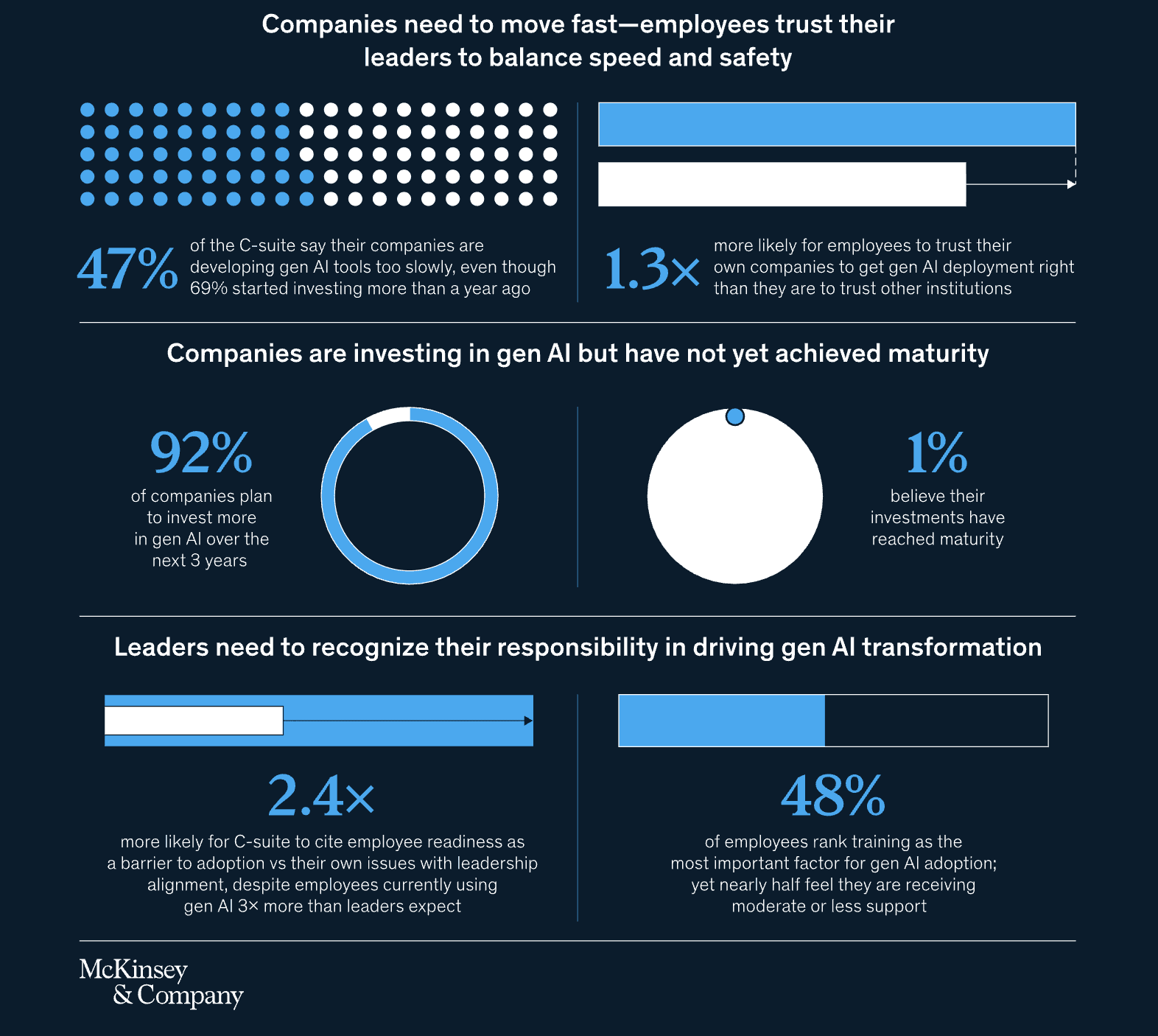
The great irony? For many, this celebrated productivity is still a projection, not a present-day reality. It's akin to the projected valuations pitched by a new business to investors, the value is based on future promise, not current returns. An MIT study found that 95% of corporate AI investments have, to date, generated zero measurable return. The AI efficiency narrative, therefore, often serves a dual purpose. It's a convenient, future-focused justification for painful but necessary cyclical layoffs, especially after a decade of over-hiring. It allows companies to reframe a simple headcount reduction as a sophisticated, forward-thinking strategy.
This exposes a clear shift in corporate priorities. The relationship between employer and employee is becoming increasingly transactional, reflecting a new business reality. Chasing perceived productivity while reducing headcount has become an accepted, and often financially incentivized, strategy. Wall Street has rewarded this approach. Layoffs are no longer universally seen as a sign of distress; in many cases, they are treated as a performance signal, a sign of decisive leadership and a strong commitment to efficiency. When Microsoft announced its last round of cuts, its stock hit a new high. This market reaction signals a clear prioritization of shareholder value and technological investment, even when it comes at the cost of human capital.
The Rebalancing Strategy
For the office worker, the concept of job safety has fundamentally changed. The stability that once differentiated office work from the factory floor is evaporating. The same wave of automation that displaced blue-collar workers is now cresting the cubicle wall/open hotel-desks.
The conversation is no longer about being future ready. The future is here, and it arrived faster than anyone’s five-year plan. The imperative now is to be present ready. The new standard for professional safety is the daily, practical application of AI. It’s no longer an abstract skill for a resume; it's a tool for survival. Learning to leverage these systems to augment your own output, to stay ahead of the automation curve is the only viable path. The cost of staying competitive is high for corporations, but for the individual, the cost of not adapting is absolute.
 |  |  |
The Accountability Vacuum: Artificial Leadership
As AI moves closer to the center of decision-making, the true job of leadership is to keep accountability firmly in human hands. The future of work won't be written by bots; it will be written in the daily, human decisions leaders make about people.
Taking responsibility begins with owning those choices. Leaders must state plainly what was decided, why, and who is accountable. Transparency is the only antidote to moral outsourcing, the act of hiding a difficult human decision behind the cold logic of a machine.
This requires re-humanizing the data. Every data point on a spreadsheet represents a person, a livelihood, a story. Before optimizing a metric, a leader must ask: Who is affected? What relationships might be broken? What trust might be lost? Data without dialogue degrades judgment.
Responsibility also means measuring what truly matters. In an age obsessed with speed, we must value the "slow variables" that make innovation possible: belonging, learning, and creativity. A committed employee needs a committed employer. This is a social contract grounded in mutual trust.
When the world's most powerful firms reduce people simply to expand their AI budgets, they send a clear signal: speed over stewardship, profits over people, efficiency over empathy. The short-term gain is easy to count; the long-term cost is not. It won't appear on a balance sheet. It will surface later, in the trust we squander, the talent we silence, and the future we forfeit.
The danger isn't artificial intelligence but rather artificial leadership.
The Recalibration in AI Workforce Dynamics:
An AI (To-Be) Company Checklist
This Week
For Leaders: Ask your teams: "What one AI tool this week saved you an hour?" Start a culture of celebrating, not just cutting, efficiency.
For Employees: Identify one repetitive daily task. Find a simple AI tool or a better prompt to speed it up.
For People (Managers): Start a shared channel or doc where your team can post one "AI win" or useful prompt.
For Machines (IT): Review a patch or update for one core AI-adjacent system (e.Sg., data pipeline, security layer).
This Month
For Leaders: Host one AI-storming session. Instead of brainstorming ideas, brainstorm processes that can be automated or augmented.
For Employees: Complete one short-form course (e.g., 2 hours) on a specific AI application relevant to your role.
For People (Managers): Identify the top 3 AI-anxious and AI-curious people on your team. Pair them for a small, low-stakes project.
For Machines (IT): Run a cost-benefit analysis on one new model or API vs. a current solution. Is the performance worth the cost?
This Quarter
For Leaders: Green light a pilot program for a new generative AI platform in one department. Define the success metric before you start.
For Employees: Build a portfolio of 3-5 tasks you have successfully augmented with AI. Present this to your manager.
For People (Managers): Redraft one job description to be AI-augmented. Focus on skills like critical thinking and prompt engineering over data entry.
For Machines (IT): Deploy and get feedback on one new internal-facing AI tool (e.g., a custom chatbot for HR or IT support).
This Year
For Leaders: Tie AI adoption and efficiency gains directly to performance reviews and compensation, not just as a cost-cutting tool but as a value-creation one.
For Employees: Become the go-to AI expert for one specific process or tool within your team or department.
For People (Managers): Launch a formal, continuous re-skilling program. Convert AI-anxious employees into AI-adept ones.
For Machines (IT): Complete a full-scale migration from one legacy system to an AI-native platform. Decommission the old machine.
This checklist is a strategic starting point. The goal is to build widespread AI literacy, moving your organization from a defensive posture to an offensive one. We must architect our new relationship with these tools. View your processes not as fixed structures, but as dynamic blueprints. Identify the load-bearing walls of human judgment and the scaffolding of repetitive tasks that AI can manage.
Intelligence vs Wisdom
Remember, AI, in its current form, is a masterful synthesizer of existing patterns. It's a reflection of the. A human, by contrast, is a navigator. You can read the room, understand the subtext, and connect disparate, real-world layers. AI provides the data, speed, and maybe an infinite number things; you provide the wisdom. There is magic in a lived experience. That is the power of critical thinking, and it remains the most valuable asset on any balance sheet. Don’t lose hope, it’s been one thing after another, I know. This technology is already restoring the human touch in medicine, where ambient AI scribes are freeing doctors from keyboards to have face-to-face conversations with patients. It’s giving a voice to the world for the visually impaired through apps that narrate their surroundings in real-time. It’s detecting diseases like cancer or diabetic retinopathy from a simple image, long before a human eye could catch them. This is the good, and we can be the ones who build it, champion it, and integrate it with purpose. Let’s find the joy, and create the vision in to reality.
Navigating the New Conversion
This article is a reflection on a massive, real-time economic shift. Here are the core ideas and what you can do about them.
Key Takeaways
The New Conversion: The conversion rate has a new meaning: the rate at which human capital (payrolls) can be converted into computing power (processors and data centers).
A Trillion-Dollar Pivot: This isn't a normal tech upgrade. It's a massive, multi-trillion-dollar reallocation of capital. This money is coming from somewhere, and in many cases, it's from headcount.
The Productivity Paradox: Many AI-driven layoffs are based on the promise of future efficiency, not a proven, current-day ROI. It's a bet on the future, justified by cutting the present.
"Present Ready" is the New Safety: Job security is no longer about a 5-year plan. It's about your immediate, daily ability to use AI tools to make your work better, faster, and smarter.
Wisdom > Intelligence: AI is a powerful tool for synthesis (organizing what's known). It cannot replace human wisdom (judgment, context, and creating what's new).
What You Can Do (As a Professional)
Become the "AI Go-To": Don't wait to be trained. Be the person on your team who experiments with new tools, finds the best prompts, and shares what works. This makes you a resource, not a redundancy.
Augment, Don't Just Automate: Use AI to handle the 80% of your job that is repetitive (drafting emails, summarizing reports, cleaning data). This frees you to focus on the critical 20% that requires your human judgment.
Build Your "Proof of Adaptation": Keep a personal log or portfolio of how you are using AI. Show how you're speeding up processes or creating better outcomes. This is the new skill to demonstrate in any performance review.
Stay Curious, Not Cynical: It's easy to be anxious about these changes. It's far more valuable to be curious. Read one article, watch one tutorial, or try one new tool each week. Small, consistent learning is the best defense against obsolescence.
A Note of Positivity

This moment isn't just an automated end; it's a creative beginning. Every great industrial shift has ultimately unlocked new forms of human expression, value, and purpose we couldn't have imagined before. This is the ultimate conversion, the one where we convert our collective anxiety into a new era of ingenuity.

The Productivity Paradox
The great irony? For many, this celebrated productivity is still a projection, not a present-day reality. It's akin to the projected valuations pitched by a new business to investors, the value is based on future promise, not current returns. An MIT study found that 95% of corporate AI investments have, to date, generated zero measurable return. The AI efficiency narrative, therefore, often serves a dual purpose. It's a convenient, future-focused justification for painful but necessary cyclical layoffs, especially after a decade of over-hiring. It allows companies to reframe a simple headcount reduction as a sophisticated, forward-thinking strategy.
This exposes a clear shift in corporate priorities. The relationship between employer and employee is becoming increasingly transactional, reflecting a new business reality. Chasing perceived productivity while reducing headcount has become an accepted, and often financially incentivized, strategy. Wall Street has rewarded this approach. Layoffs are no longer universally seen as a sign of distress; in many cases, they are treated as a performance signal, a sign of decisive leadership and a strong commitment to efficiency. When Microsoft announced its last round of cuts, its stock hit a new high. This market reaction signals a clear prioritization of shareholder value and technological investment, even when it comes at the cost of human capital.
The Rebalancing Strategy
For the office worker, the concept of job safety has fundamentally changed. The stability that once differentiated office work from the factory floor is evaporating. The same wave of automation that displaced blue-collar workers is now cresting the cubicle wall/open hotel-desks.
The conversation is no longer about being future ready. The future is here, and it arrived faster than anyone’s five-year plan. The imperative now is to be present ready. The new standard for professional safety is the daily, practical application of AI. It’s no longer an abstract skill for a resume; it's a tool for survival. Learning to leverage these systems to augment your own output, to stay ahead of the automation curve is the only viable path. The cost of staying competitive is high for corporations, but for the individual, the cost of not adapting is absolute.
| | |
The Accountability Vacuum: Artificial Leadership
As AI moves closer to the center of decision-making, the true job of leadership is to keep accountability firmly in human hands. The future of work won't be written by bots; it will be written in the daily, human decisions leaders make about people.
Taking responsibility begins with owning those choices. Leaders must state plainly what was decided, why, and who is accountable. Transparency is the only antidote to moral outsourcing, the act of hiding a difficult human decision behind the cold logic of a machine.
This requires re-humanizing the data. Every data point on a spreadsheet represents a person, a livelihood, a story. Before optimizing a metric, a leader must ask: Who is affected? What relationships might be broken? What trust might be lost? Data without dialogue degrades judgment.
Responsibility also means measuring what truly matters. In an age obsessed with speed, we must value the "slow variables" that make innovation possible: belonging, learning, and creativity. A committed employee needs a committed employer. This is a social contract grounded in mutual trust.
When the world's most powerful firms reduce people simply to expand their AI budgets, they send a clear signal: speed over stewardship, profits over people, efficiency over empathy. The short-term gain is easy to count; the long-term cost is not. It won't appear on a balance sheet. It will surface later, in the trust we squander, the talent we silence, and the future we forfeit.
The danger isn't artificial intelligence but rather artificial leadership.
The Recalibration in AI Workforce Dynamics:
An AI (To-Be) Company Checklist
This Week
For Leaders: Ask your teams: "What one AI tool this week saved you an hour?" Start a culture of celebrating, not just cutting, efficiency.
For Employees: Identify one repetitive daily task. Find a simple AI tool or a better prompt to speed it up.
For People (Managers): Start a shared channel or doc where your team can post one "AI win" or useful prompt.
For Machines (IT): Review a patch or update for one core AI-adjacent system (e.Sg., data pipeline, security layer).
This Month
For Leaders: Host one AI-storming session. Instead of brainstorming ideas, brainstorm processes that can be automated or augmented.
For Employees: Complete one short-form course (e.g., 2 hours) on a specific AI application relevant to your role.
For People (Managers): Identify the top 3 AI-anxious and AI-curious people on your team. Pair them for a small, low-stakes project.
For Machines (IT): Run a cost-benefit analysis on one new model or API vs. a current solution. Is the performance worth the cost?
This Quarter
For Leaders: Green light a pilot program for a new generative AI platform in one department. Define the success metric before you start.
For Employees: Build a portfolio of 3-5 tasks you have successfully augmented with AI. Present this to your manager.
For People (Managers): Redraft one job description to be AI-augmented. Focus on skills like critical thinking and prompt engineering over data entry.
For Machines (IT): Deploy and get feedback on one new internal-facing AI tool (e.g., a custom chatbot for HR or IT support).
This Year
For Leaders: Tie AI adoption and efficiency gains directly to performance reviews and compensation, not just as a cost-cutting tool but as a value-creation one.
For Employees: Become the go-to AI expert for one specific process or tool within your team or department.
For People (Managers): Launch a formal, continuous re-skilling program. Convert AI-anxious employees into AI-adept ones.
For Machines (IT): Complete a full-scale migration from one legacy system to an AI-native platform. Decommission the old machine.
This checklist is a strategic starting point. The goal is to build widespread AI literacy, moving your organization from a defensive posture to an offensive one. We must architect our new relationship with these tools. View your processes not as fixed structures, but as dynamic blueprints. Identify the load-bearing walls of human judgment and the scaffolding of repetitive tasks that AI can manage.
Intelligence vs Wisdom
Remember, AI, in its current form, is a masterful synthesizer of existing patterns. It's a reflection of the. A human, by contrast, is a navigator. You can read the room, understand the subtext, and connect disparate, real-world layers. AI provides the data, speed, and maybe an infinite number things; you provide the wisdom. There is magic in a lived experience. That is the power of critical thinking, and it remains the most valuable asset on any balance sheet. Don’t lose hope, it’s been one thing after another, I know. This technology is already restoring the human touch in medicine, where ambient AI scribes are freeing doctors from keyboards to have face-to-face conversations with patients. It’s giving a voice to the world for the visually impaired through apps that narrate their surroundings in real-time. It’s detecting diseases like cancer or diabetic retinopathy from a simple image, long before a human eye could catch them. This is the good, and we can be the ones who build it, champion it, and integrate it with purpose. Let’s find the joy, and create the vision in to reality.
Navigating the New Conversion
This article is a reflection on a massive, real-time economic shift. Here are the core ideas and what you can do about them.
Key Takeaways
The New Conversion: The conversion rate has a new meaning: the rate at which human capital (payrolls) can be converted into computing power (processors and data centers).
A Trillion-Dollar Pivot: This isn't a normal tech upgrade. It's a massive, multi-trillion-dollar reallocation of capital. This money is coming from somewhere, and in many cases, it's from headcount.
The Productivity Paradox: Many AI-driven layoffs are based on the promise of future efficiency, not a proven, current-day ROI. It's a bet on the future, justified by cutting the present.
"Present Ready" is the New Safety: Job security is no longer about a 5-year plan. It's about your immediate, daily ability to use AI tools to make your work better, faster, and smarter.
Wisdom > Intelligence: AI is a powerful tool for synthesis (organizing what's known). It cannot replace human wisdom (judgment, context, and creating what's new).
What You Can Do (As a Professional)
Become the "AI Go-To": Don't wait to be trained. Be the person on your team who experiments with new tools, finds the best prompts, and shares what works. This makes you a resource, not a redundancy.
Augment, Don't Just Automate: Use AI to handle the 80% of your job that is repetitive (drafting emails, summarizing reports, cleaning data). This frees you to focus on the critical 20% that requires your human judgment.
Build Your "Proof of Adaptation": Keep a personal log or portfolio of how you are using AI. Show how you're speeding up processes or creating better outcomes. This is the new skill to demonstrate in any performance review.
Stay Curious, Not Cynical: It's easy to be anxious about these changes. It's far more valuable to be curious. Read one article, watch one tutorial, or try one new tool each week. Small, consistent learning is the best defense against obsolescence.
A Note of Positivity
This moment isn't just an automated end; it's a creative beginning. Every great industrial shift has ultimately unlocked new forms of human expression, value, and purpose we couldn't have imagined before. This is the ultimate conversion, the one where we convert our collective anxiety into a new era of ingenuity.
The Productivity Paradox
The great irony? For many, this celebrated productivity is still a projection, not a present-day reality. It's akin to the projected valuations pitched by a new business to investors, the value is based on future promise, not current returns. An MIT study found that 95% of corporate AI investments have, to date, generated zero measurable return. The AI efficiency narrative, therefore, often serves a dual purpose. It's a convenient, future-focused justification for painful but necessary cyclical layoffs, especially after a decade of over-hiring. It allows companies to reframe a simple headcount reduction as a sophisticated, forward-thinking strategy.
This exposes a clear shift in corporate priorities. The relationship between employer and employee is becoming increasingly transactional, reflecting a new business reality. Chasing perceived productivity while reducing headcount has become an accepted, and often financially incentivized, strategy. Wall Street has rewarded this approach. Layoffs are no longer universally seen as a sign of distress; in many cases, they are treated as a performance signal, a sign of decisive leadership and a strong commitment to efficiency. When Microsoft announced its last round of cuts, its stock hit a new high. This market reaction signals a clear prioritization of shareholder value and technological investment, even when it comes at the cost of human capital.
The Rebalancing Strategy
For the office worker, the concept of job safety has fundamentally changed. The stability that once differentiated office work from the factory floor is evaporating. The same wave of automation that displaced blue-collar workers is now cresting the cubicle wall/open hotel-desks.
The conversation is no longer about being future ready. The future is here, and it arrived faster than anyone’s five-year plan. The imperative now is to be present ready. The new standard for professional safety is the daily, practical application of AI. It’s no longer an abstract skill for a resume; it's a tool for survival. Learning to leverage these systems to augment your own output, to stay ahead of the automation curve is the only viable path. The cost of staying competitive is high for corporations, but for the individual, the cost of not adapting is absolute.
| | |
The Accountability Vacuum: Artificial Leadership
As AI moves closer to the center of decision-making, the true job of leadership is to keep accountability firmly in human hands. The future of work won't be written by bots; it will be written in the daily, human decisions leaders make about people.
Taking responsibility begins with owning those choices. Leaders must state plainly what was decided, why, and who is accountable. Transparency is the only antidote to moral outsourcing, the act of hiding a difficult human decision behind the cold logic of a machine.
This requires re-humanizing the data. Every data point on a spreadsheet represents a person, a livelihood, a story. Before optimizing a metric, a leader must ask: Who is affected? What relationships might be broken? What trust might be lost? Data without dialogue degrades judgment.
Responsibility also means measuring what truly matters. In an age obsessed with speed, we must value the "slow variables" that make innovation possible: belonging, learning, and creativity. A committed employee needs a committed employer. This is a social contract grounded in mutual trust.
When the world's most powerful firms reduce people simply to expand their AI budgets, they send a clear signal: speed over stewardship, profits over people, efficiency over empathy. The short-term gain is easy to count; the long-term cost is not. It won't appear on a balance sheet. It will surface later, in the trust we squander, the talent we silence, and the future we forfeit.
The danger isn't artificial intelligence but rather artificial leadership.
The Recalibration in AI Workforce Dynamics:
An AI (To-Be) Company Checklist
This Week
For Leaders: Ask your teams: "What one AI tool this week saved you an hour?" Start a culture of celebrating, not just cutting, efficiency.
For Employees: Identify one repetitive daily task. Find a simple AI tool or a better prompt to speed it up.
For People (Managers): Start a shared channel or doc where your team can post one "AI win" or useful prompt.
For Machines (IT): Review a patch or update for one core AI-adjacent system (e.Sg., data pipeline, security layer).
This Month
For Leaders: Host one AI-storming session. Instead of brainstorming ideas, brainstorm processes that can be automated or augmented.
For Employees: Complete one short-form course (e.g., 2 hours) on a specific AI application relevant to your role.
For People (Managers): Identify the top 3 AI-anxious and AI-curious people on your team. Pair them for a small, low-stakes project.
For Machines (IT): Run a cost-benefit analysis on one new model or API vs. a current solution. Is the performance worth the cost?
This Quarter
For Leaders: Green light a pilot program for a new generative AI platform in one department. Define the success metric before you start.
For Employees: Build a portfolio of 3-5 tasks you have successfully augmented with AI. Present this to your manager.
For People (Managers): Redraft one job description to be AI-augmented. Focus on skills like critical thinking and prompt engineering over data entry.
For Machines (IT): Deploy and get feedback on one new internal-facing AI tool (e.g., a custom chatbot for HR or IT support).
This Year
For Leaders: Tie AI adoption and efficiency gains directly to performance reviews and compensation, not just as a cost-cutting tool but as a value-creation one.
For Employees: Become the go-to AI expert for one specific process or tool within your team or department.
For People (Managers): Launch a formal, continuous re-skilling program. Convert AI-anxious employees into AI-adept ones.
For Machines (IT): Complete a full-scale migration from one legacy system to an AI-native platform. Decommission the old machine.
This checklist is a strategic starting point. The goal is to build widespread AI literacy, moving your organization from a defensive posture to an offensive one. We must architect our new relationship with these tools. View your processes not as fixed structures, but as dynamic blueprints. Identify the load-bearing walls of human judgment and the scaffolding of repetitive tasks that AI can manage.
Intelligence vs Wisdom
Remember, AI, in its current form, is a masterful synthesizer of existing patterns. It's a reflection of the. A human, by contrast, is a navigator. You can read the room, understand the subtext, and connect disparate, real-world layers. AI provides the data, speed, and maybe an infinite number things; you provide the wisdom. There is magic in a lived experience. That is the power of critical thinking, and it remains the most valuable asset on any balance sheet. Don’t lose hope, it’s been one thing after another, I know. This technology is already restoring the human touch in medicine, where ambient AI scribes are freeing doctors from keyboards to have face-to-face conversations with patients. It’s giving a voice to the world for the visually impaired through apps that narrate their surroundings in real-time. It’s detecting diseases like cancer or diabetic retinopathy from a simple image, long before a human eye could catch them. This is the good, and we can be the ones who build it, champion it, and integrate it with purpose. Let’s find the joy, and create the vision in to reality.
Navigating the New Conversion
This article is a reflection on a massive, real-time economic shift. Here are the core ideas and what you can do about them.
Key Takeaways
The New Conversion: The conversion rate has a new meaning: the rate at which human capital (payrolls) can be converted into computing power (processors and data centers).
A Trillion-Dollar Pivot: This isn't a normal tech upgrade. It's a massive, multi-trillion-dollar reallocation of capital. This money is coming from somewhere, and in many cases, it's from headcount.
The Productivity Paradox: Many AI-driven layoffs are based on the promise of future efficiency, not a proven, current-day ROI. It's a bet on the future, justified by cutting the present.
"Present Ready" is the New Safety: Job security is no longer about a 5-year plan. It's about your immediate, daily ability to use AI tools to make your work better, faster, and smarter.
Wisdom > Intelligence: AI is a powerful tool for synthesis (organizing what's known). It cannot replace human wisdom (judgment, context, and creating what's new).
What You Can Do (As a Professional)
Become the "AI Go-To": Don't wait to be trained. Be the person on your team who experiments with new tools, finds the best prompts, and shares what works. This makes you a resource, not a redundancy.
Augment, Don't Just Automate: Use AI to handle the 80% of your job that is repetitive (drafting emails, summarizing reports, cleaning data). This frees you to focus on the critical 20% that requires your human judgment.
Build Your "Proof of Adaptation": Keep a personal log or portfolio of how you are using AI. Show how you're speeding up processes or creating better outcomes. This is the new skill to demonstrate in any performance review.
Stay Curious, Not Cynical: It's easy to be anxious about these changes. It's far more valuable to be curious. Read one article, watch one tutorial, or try one new tool each week. Small, consistent learning is the best defense against obsolescence.
A Note of Positivity
This moment isn't just an automated end; it's a creative beginning. Every great industrial shift has ultimately unlocked new forms of human expression, value, and purpose we couldn't have imagined before. This is the ultimate conversion, the one where we convert our collective anxiety into a new era of ingenuity.